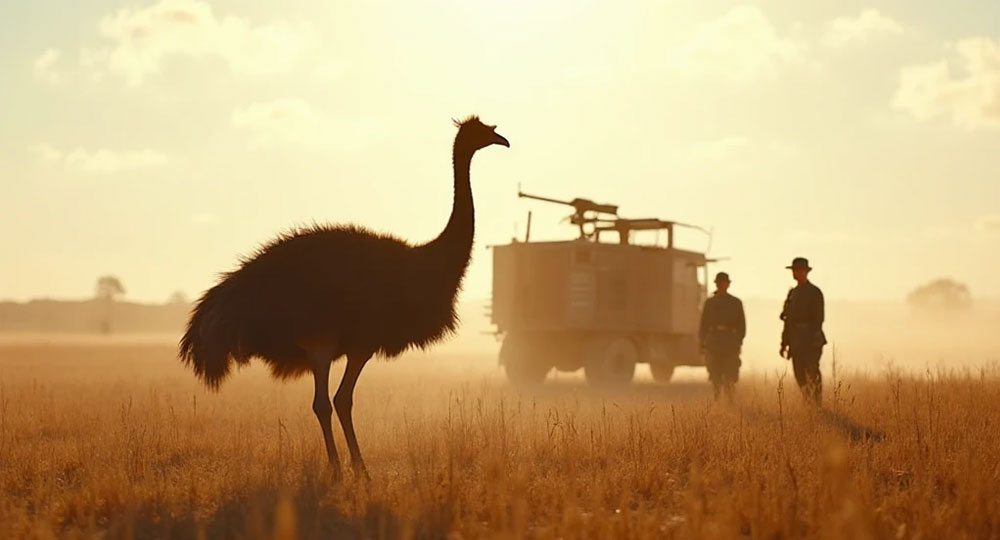
The Great Emu War: Australia’s Battle Against Birds
Imagine a war where the enemy can’t fly, doesn’t use weapons, and has no idea it’s even in a conflict. Yet, despite facing machine guns and military tactics, this enemy emerges victorious. This isn’t a fictional tale or a bizarre dream, it’s a real chapter in Australian history known as the Great Emu War. In 1932, the Australian government declared war on emus, large flightless birds native to the continent, and the results were both humbling and absurd. Let’s dive into one of the most unusual military operations ever undertaken, a story of human ingenuity versus nature’s resilience.
Background: Why Go to War Against Birds?
To understand how Australia found itself in a military conflict with birds, we need to look at the historical context. After World War I, the Australian government launched a soldier settlement scheme to provide land and livelihoods for returning veterans. Many were given plots in Western Australia, often in marginal, drought-prone areas unsuitable for farming. These inexperienced farmers faced immense challenges, from poor soil to unpredictable rainfall. The Great Depression of the 1930s worsened their situation, causing wheat prices to plummet and promised government subsidies to vanish.
Enter the emus. These flightless birds, standing up to six feet tall and capable of running at speeds of 30 miles per hour, are native to Australia and play a vital role in the ecosystem. Each year, emus migrate from inland regions to the coast after breeding season. In 1932, drought conditions drove approximately 20,000 emus into the farmlands of Western Australia. The cultivated fields, with their abundant crops and water supplies, became an irresistible buffet for the birds. Emus devoured wheat, trampled fields, and broke down fences, allowing rabbits and other pests to cause further damage. For farmers already struggling with economic hardship, this was the final straw.
Desperate for a solution, a group of veteran farmers petitioned the government for help. Having witnessed the effectiveness of machine guns during the war, they requested military support to cull the emu population. Sir George Pearce, the Minister of Defence, saw this as an opportunity to demonstrate government support for the veterans and possibly stave off growing secessionist sentiments in Western Australia. He approved the deployment of soldiers armed with Lewis guns, marking the beginning of the Great Emu War.
The Military Operation Begins
In early November 1932, the Australian military arrived in the Campion district of Western Australia. The operation was led by Major G.P.W. Meredith of the Royal Australian Artillery, accompanied by Sergeant S. McMurray and Gunner J. O’Halloran. Their equipment included two Lewis machine guns and 10,000 rounds of ammunition. A cinematographer from Fox Movietone was also present, suggesting that the government hoped to use the operation for propaganda purposes.
The initial plan was straightforward: ambush large groups of emus and mow them down with machine gun fire. However, the emus had other ideas. On November 2, the soldiers encountered a group of about 50 birds. The emus were out of range, so local settlers tried to herd them toward the guns. Instead of cooperating, the birds split into small groups and ran in different directions, making them difficult targets. The soldiers managed to kill only a few emus that day.
Two days later, the military set up an ambush near a dam where over 1,000 emus had gathered. The gunners waited until the birds were within close range before opening fire. But after killing only about a dozen emus, one of the machine guns jammed. The birds scattered, and the soldiers were left empty-handed. This pattern continued over the next several days. The emus proved to be elusive and unpredictable adversaries. They moved in small, agile groups, often with a lookout, a large, black-plumed bird, keeping watch for danger. When threatened, they would scatter or run at high speeds, making them nearly impossible to hit.
Frustrated, Major Meredith tried mounting a machine gun on a truck to chase down the birds. This tactic also failed. The rough terrain made it impossible to aim accurately, and the emus easily outran the vehicle. In one incident, a truck even crashed after hitting an emu, adding to the operation’s absurdity. After six days, the soldiers had used 2,500 rounds of ammunition but had killed only a fraction of the emu population. Estimates varied widely, from 50 to 500 birds, but the results were undeniably disappointing.
Public Reaction and Media Ridicule
News of the military’s struggles quickly spread, and the media had a field day. Newspapers across Australia and internationally mocked the operation, dubbing it the “Emu War.” Reports highlighted the birds’ tactical superiority, with one journalist noting that the emus had “won every round so far.” Politicians joined in the ridicule. A member of the Australian House of Representatives joked that medals should be awarded to the emus for their resilience.
The public’s sympathy began to shift toward the birds. Conservationists in the United Kingdom protested the cull, calling it an inhumane extermination of a rare species. Even Australian ornithologists criticized the operation as a misguided attempt at mass destruction. The negative publicity forced the government to temporarily withdraw the military on November 8. However, under pressure from farmers and the Premier of Western Australia, the soldiers were redeployed a few days later.
The second phase of the operation saw slightly better results. Major Meredith reported that his team killed about 100 emus per week by setting up ambushes near water sources. By December 10, when the operation was finally called off, Meredith claimed 986 confirmed kills and estimated that another 2,500 birds had died from their injuries. He noted that it took exactly 10 rounds of ammunition to kill each emu, a statistic that many historians find suspiciously convenient. Regardless, the overall impact on the emu population was minimal, and the birds continued to plague farmers.
Why Did the Military Fail?
The failure of the Great Emu War can be attributed to several factors, including the emus’ biology, the environment, and poor military planning.
-
Emu Adaptability and Resilience: Emus are incredibly resilient birds. They can run at speeds up to 30 miles per hour, cover vast distances in search of food and water, and survive in harsh conditions. Their tough feathers and muscular bodies allowed them to withstand bullet wounds, with some reports of emus running long distances even after being shot multiple times. Major Meredith himself compared them to tanks, noting their “invulnerability to machine guns.”
-
Ineffective Tactics and Equipment: The military’s tactics were ill-suited for the environment. The Lewis guns, designed for warfare, were ineffective against scattered, fast-moving birds. Mounting guns on trucks proved useless due to the rough terrain and the emus’ speed. The soldiers also underestimated the birds’ intelligence. Emus quickly learned to avoid open areas and moved in smaller groups, making them harder to target.
-
Environmental Challenges: The vast, open landscapes of Western Australia made it easy for emus to spot threats and escape. Drought conditions had concentrated the birds around farms, but rain earlier in the season had also scattered them over a wider area, reducing the effectiveness of ambushes.
-
Lack of Preparation: The operation was rushed and poorly planned. The government did not consult the Military Board in Canberra before deploying the soldiers, and there was no clear strategy for dealing with the birds. The decision to use machine guns was based on the farmers’ requests rather than practical considerations.
Aftermath and Legacy
After the military withdrawal, the government implemented more effective solutions to the emu problem. A bounty system was introduced, rewarding farmers for killing emus. In just six months in 1934, over 57,000 bounties were claimed. Additionally, farmers built stronger exclusion fences to keep emus out of their fields. These measures proved far more successful than military intervention.
Despite the initial failure, the Great Emu War left a lasting legacy. It highlighted the importance of understanding wildlife behavior and the limitations of using force against nature. Today, emus are protected under Australian environmental law, and their population is thriving, with an estimated 600,000 to 700,000 birds in the wild. Emus hold a special place in Australian culture, appearing on the national coat of arms, the 50-cent coin, and as symbols of resilience and adaptability.
The story of the Emu War has also captured the public’s imagination. It has been the subject of documentaries, articles, and even a musical adaptation. An action-comedy film titled The Emu War premiered in 2023, and another project involving John Cleese is in the works. These retellings keep the memory of the conflict alive, often with a humorous twist.
Lessons from the Emu War
The Great Emu War serves as a reminder that nature cannot be conquered through brute force alone. It underscores the need for sustainable and humane approaches to wildlife management. Moreover, it illustrates the importance of humility in the face of nature’s unpredictability. As we continue to navigate the challenges of coexisting with wildlife, the Emu War offers a cautionary tale about the consequences of underestimating the natural world.
In the end, the emus won not through strategy or strength but simply by being themselves, resilient, adaptable, and utterly unconcerned with human conflicts. Their victory is a testament to the enduring power of nature and a lesson in humility for us all.
References
|